Factors That Affect the Forex Market
BY Panagiotis Philippou
|March 20, 2026The forex market doesn't move randomly. Currency values shift based on specific, identifiable factors that traders can learn to recognize and analyze. Understanding the factors affecting the forex market is your foundation for making informed trading decisions rather than guessing which direction a currency pair might move.
The foreign exchange market is the largest and most liquid financial market globally, with over $7 trillion traded daily across major financial centers. Currency prices constantly fluctuate based on economic data releases, political developments, central bank policy decisions, and shifts in market sentiment. These aren't abstract concepts—they're real-world events that create the price movements you see on your charts.
This guide breaks down the main categories of factors driving forex markets: economic indicators, political events, central bank actions, market sentiment, and global news. We'll explain how each factor works individually and how they interact to create trading opportunities. By the end, you'll have a practical framework for analyzing what moves the currency pairs you're interested in trading.
What factors affect the forex market?
At its core, currency valuation follows supply and demand dynamics. When demand for a currency increases relative to another, its value rises. When demand decreases, its value falls. The factors affecting the forex market are essentially the forces that shift supply and demand for different currencies.
Think of it this way: currencies represent economies. When an economy shows strength through positive data, stable politics, and sound monetary policy, demand for that currency typically increases. When an economy shows weakness or uncertainty, demand typically decreases. Multiple participants—from central banks and institutional investors to hedge funds and retail traders—constantly evaluate these factors and adjust their positions accordingly.
Some factors are scheduled and predictable, like monthly employment reports or quarterly central bank meetings. Others arrive unexpectedly, like political upheavals or natural disasters. Both types create trading opportunities, but they require different approaches to analysis and risk management.
| Factor Category | Specific Factor | Condition for Currency Strength | Condition for Currency Weakness |
| Economic | Interest Rates & Monetary Policy | Higher interest rates (Hawkish policy) | Lower interest rates (Dovish policy) |
| Economic | Inflation Rates | Consistently lower inflation rates (maintains purchasing power) | High inflation (erodes purchasing power) |
| Economic | Economic Growth (GDP) | Strong or expanding GDP growth | Weak or negative GDP growth (contraction) |
| Economic | Employment Data | Strong employment data (e.g., strong Non-Farm Payrolls) | Rising unemployment (weak consumer spending) |
| Economic | Trade Balance & Current Account | Trade surplus and Current Account surplus (net lender) | Trade deficit and Current Account deficit (net borrower) |
| Political | Stability & Policies | Stable government, transparent legal systems, predictable policies | Political instability, corruption, unpredictable policy changes |
| Political | Elections & Events | Outcome viewed as positive for economic stability/growth | Outcome viewed as negative for economic stability/growth (disruption) |
| Political | Geopolitical Tensions | Flight to safe-haven currencies (e.g., USD, JPY, CHF) | Currencies of countries directly involved or affected by tensions |
| Market Sentiment | Risk Appetite | Risk-on environment (investors seek higher-yielding/riskier assets) | Risk-off environment (investors seek safety, sell riskier assets) |
| Global Events | Unexpected Events | Generally triggers flight to safe-haven currencies | Directly affects major economies (e.g., natural disasters, sanctions) |
Economic factors affecting the forex market
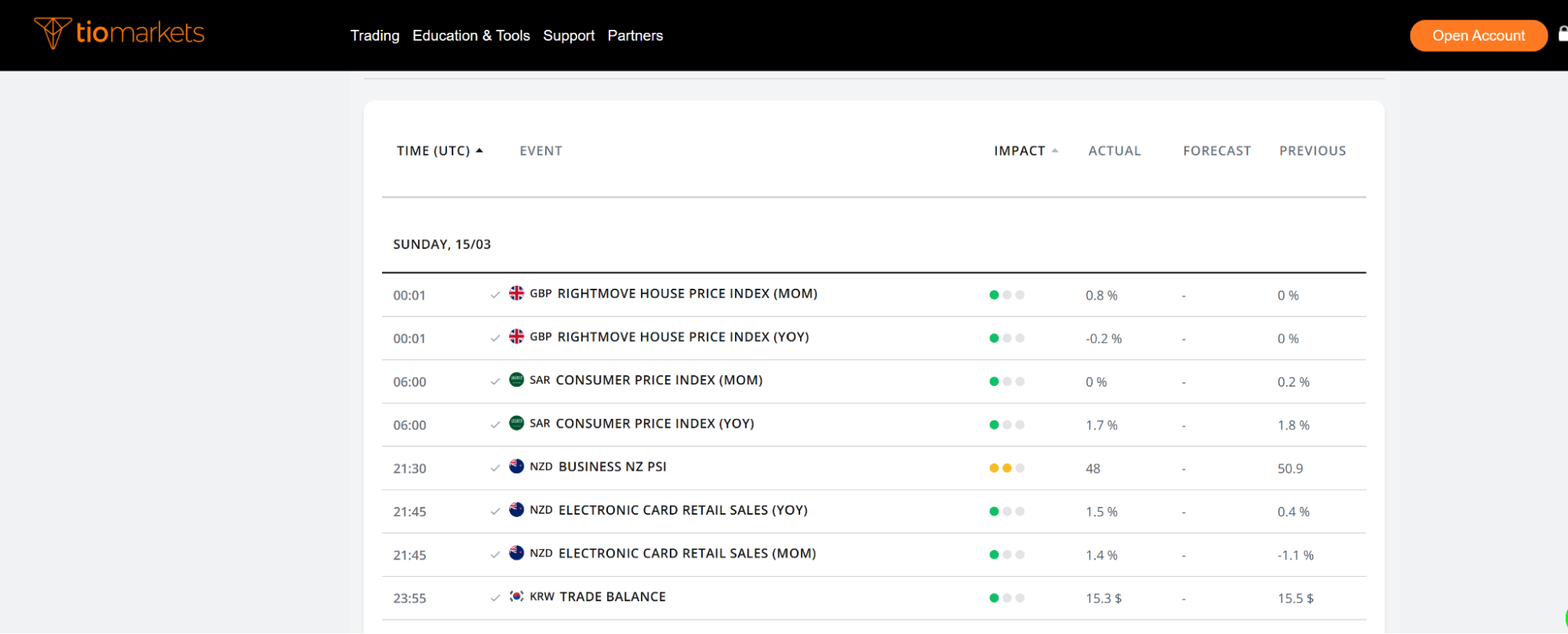
Economic conditions form the foundation of long-term currency valuation. Strong economic performance typically strengthens a currency over time, while persistent economic weakness tends to weaken it. You can monitor the economic events, and their likely impact on the forex market on the TIOmarkets economic calendar.
Interest rates and monetary policy
Interest rates rank among the most powerful drivers of currency values. Central banks set benchmark interest rates to control inflation and manage economic growth. These rate decisions directly impact currency attractiveness to international investors.
Higher interest rates typically attract foreign capital. Investors seeking better returns move money into deposits, bonds, and other assets denominated in the higher-yielding currency. This increased demand strengthens the currency. Lower interest rates have the opposite effect—they make a currency less attractive, potentially weakening it as capital flows elsewhere.
Major central banks include the Federal Reserve (United States), European Central Bank (Eurozone), Bank of Japan, and Bank of England. Their monetary policy decisions create ripple effects throughout forex markets. Volatility often spikes around policy announcement times as traders react to rate decisions and forward guidance about future policy direction.
Inflation rates
Inflation measures how quickly prices for goods and services rise over time. Central banks typically target moderate inflation rates around 2% annually, viewing this as healthy for economic growth. High inflation erodes purchasing power and can weaken a currency, while very low inflation or deflation can signal economic weakness.
Countries with consistently lower inflation rates typically see their currencies appreciate relative to countries with higher inflation. The currency maintains its purchasing power better over time, making it more attractive to hold. Central banks closely monitor inflation data and adjust interest rates accordingly to keep inflation within target ranges.
Traders watch inflation reports closely because they often signal future central bank actions. Rising inflation may prompt rate increases, while falling inflation may lead to rate cuts. This makes inflation data a leading indicator of monetary policy changes that directly affect currency values.
Economic growth and GDP
Gross Domestic Product (GDP) measures the total value of goods and services produced within a country. It's the broadest measure of economic activity and health. Strong GDP growth indicates an expanding economy, which typically supports currency strength. Weak or negative GDP growth suggests economic contraction, which can weaken the currency.
Forex traders monitor quarterly GDP reports and year-over-year growth comparisons. However, GDP is a lagging indicator—it reports what already happened rather than predicting future performance. A country might report strong GDP for the previous quarter while current conditions are already deteriorating.
Despite this limitation, consistent GDP growth attracts foreign investment and supports currency strength over the long term. Investors prefer economies that are growing, as this creates business opportunities and investment returns. Sustained GDP growth also tends to support employment and consumer spending, creating a positive feedback loop.
Employment data
Employment indicators provide real-time insight into economic health and consumer spending power. When employment is strong, consumers have income to spend, supporting economic growth. When unemployment rises, consumer spending typically falls, potentially weakening the economy and currency.
Key employment metrics include the unemployment rate, job creation figures, and jobless claims. In the United States, the Non-Farm Payrolls (NFP) report released on the first Friday of each month is one of the most closely watched economic indicators globally. This report shows how many jobs were added or lost in the previous month, excluding farm workers and a few other categories.
Significant deviations from expectations in employment data can create substantial volatility in currency pairs. A much stronger than expected jobs report might strengthen the currency as traders anticipate potential interest rate increases. A much weaker report might weaken it as traders price in potential rate cuts or economic concerns.
Trade balance and current account
The trade balance measures the difference between a country's exports and imports of goods. A trade surplus (more exports than imports) generally supports currency strength. Foreign buyers must purchase the currency to pay for exported goods, creating demand. A trade deficit (more imports than exports) can weaken a currency, as domestic buyers sell their currency to purchase foreign goods.
The current account is broader than the trade balance. It includes trade in goods and services, plus investment income and transfers. A current account surplus indicates a country is a net lender to the rest of the world, while a deficit indicates it's a net borrower.
These balances influence long-term currency trends and investor confidence. Countries with persistent large deficits may see their currencies weaken over time as they rely on foreign capital inflows to finance the deficit. Countries with surpluses typically see their currencies strengthen as they accumulate foreign assets.
Political factors affecting the forex market
Political stability and government policies significantly impact currency values. Political uncertainty creates risk, which typically drives investors toward safer assets and currencies. Understanding political factors helps you anticipate potential volatility and manage risk appropriately.
Political stability and government policies
Countries with stable governments, transparent legal systems, and predictable policy environments tend to attract foreign investment. This capital inflow supports their currencies. Political instability, corruption, or unpredictable policy changes can drive capital away, weakening the currency as investors seek safer opportunities elsewhere.
Government policies in three main areas directly affect forex markets:
Fiscal policy: Government spending and taxation decisions influence economic growth, inflation, and budget deficits. Expansionary fiscal policy (increased spending or tax cuts) can stimulate growth but may also increase deficits and inflation. Contractionary fiscal policy (spending cuts or tax increases) can slow growth but may improve fiscal sustainability.
Trade policy: Tariffs, trade agreements, and protectionist measures affect trade balances and international economic relationships. New tariffs might reduce imports and improve the trade balance short-term, but they can also trigger retaliation and harm export industries.
Regulatory changes: New regulations affecting businesses, banking, or capital flows can impact investor confidence and economic activity. Deregulation might attract investment and strengthen the currency, while heavy new regulations might have the opposite effect.
Elections and political events
Elections introduce uncertainty because different candidates or parties may pursue vastly different economic policies. Markets generally dislike uncertainty, so forex volatility often increases in the weeks and months surrounding major elections.
The election outcome can strengthen or weaken a currency depending on whether markets view the result as positive or negative for economic stability and growth. A pro-business candidate winning might strengthen the currency if markets expect growth-friendly policies. A candidate proposing major economic changes might weaken it if markets fear disruption or uncertainty.
Beyond elections, other political events like government collapses, leadership changes, referendums, and policy announcements can all create currency movements. The key is whether the event increases or decreases confidence in the country's economic future and policy stability.
Geopolitical tensions
International conflicts, trade disputes, sanctions, and diplomatic tensions create uncertainty that affects currency markets. During periods of heightened geopolitical risk, investors often move capital toward safe-haven currencies and away from currencies of countries directly involved in or affected by the tensions.
Trade wars between major economies can significantly impact currencies. Tariffs and counter-tariffs affect trade balances, economic growth, and inflation in the countries involved. Military conflicts or threats create uncertainty that typically strengthens safe-haven currencies while weakening currencies of countries in the conflict zone or economically dependent on the region.
Sanctions can dramatically affect a country's currency by restricting its access to international financial systems and trade. The sanctioned country's currency typically weakens as its economy faces reduced export opportunities and limited access to foreign capital.
Market sentiment and speculation
Beyond hard economic data and political events, market psychology plays a crucial role in currency movements. How traders collectively feel about risk and opportunity can drive significant price action, sometimes amplifying or contradicting what fundamental factors alone would suggest.
Risk appetite vs risk aversion
Forex markets alternate between "risk-on" and "risk-off" environments based on overall investor confidence. Understanding this dynamic helps you anticipate how different currencies might react to news and events.
In risk-on periods, investors feel confident about economic growth and are willing to invest in higher-yielding but potentially riskier assets and currencies. During these times, currencies of emerging markets or commodity-exporting countries often strengthen as investors seek higher returns.
In risk-off periods, uncertainty or fear drives investors toward safety. They sell riskier assets and currencies, moving capital into safe-haven currencies and assets like government bonds. These shifts can happen quickly when unexpected negative news hits the markets.
Market psychology and trader behavior
Many times, the factors affecting the Forex Market can also be psychological. Forex markets involve millions of participants, from large institutional investors and hedge funds managing billions to retail traders managing thousands. Collective behavior, driven by emotions like fear and greed, can amplify price movements beyond what fundamental factors alone would justify.
Leverage in forex trading amplifies these psychological effects. Because traders can control large positions with relatively small capital, even modest price movements can trigger significant gains or losses. This creates cascading effects when many traders hit stop-loss levels simultaneously or rush to enter positions based on breaking news.
Common psychological biases affect forex trading decisions:
- Herd mentality: Traders follow the crowd, buying when everyone else is buying and selling when everyone else is selling. This amplifies trends but can also create bubbles and crashes.
- Confirmation bias: Traders seek information that confirms their existing beliefs while ignoring contradictory evidence. This can lead to holding losing positions too long or missing warning signs.
- Recency bias: Traders give too much weight to recent events and assume recent trends will continue. This can lead to buying at tops or selling at bottoms.
- Loss aversion: Traders feel the pain of losses more strongly than the pleasure of equivalent gains. This can lead to cutting winning trades too early while holding losing trades too long.
Understanding these biases in yourself and recognizing them in market behavior helps you make more rational trading decisions.
Central bank actions
Central banks are the most influential individual players in forex markets. Their decisions on interest rates and other policy tools directly impact currency values, often creating the strongest and most sustained trends in forex markets.
Monetary policy decisions
Central banks meet regularly to assess economic conditions and set monetary policy. The Federal Reserve, European Central Bank, Bank of Japan, and Bank of England are among the most influential. Their decisions on benchmark interest rates create immediate reactions in forex markets, often with volatility spiking around announcement times.
A hawkish stance (favoring higher interest rates to combat inflation) typically strengthens a currency. When a central bank signals it may raise rates or continue raising them, traders anticipate higher yields and increased foreign investment, driving the currency higher.
A dovish stance (favoring lower interest rates to stimulate growth) typically weakens a currency. When a central bank signals it may cut rates or keep them low, traders anticipate lower yields and reduced foreign investment, driving the currency lower.
Traders analyze central bank statements carefully for clues about future policy direction. The specific language used in policy statements, the tone of press conferences, and the economic projections released alongside decisions all provide insight into how the central bank views the economy and what actions it might take next.
Central bank communications
Modern central banks don't just act—they communicate extensively about their thinking and future intentions. This communication itself has become a policy tool, as central banks learned that managing market expectations can be as important as the actual policy actions.
Forward guidance refers to explicit statements about likely future policy. A central bank might say "we expect to keep interest rates at current levels through the end of the year" or "we anticipate beginning to reduce our balance sheet in the coming months." These statements help markets prepare for future actions and can influence current currency values even before any actual policy change occurs.
Central bank communications can move currencies significantly. A more hawkish than expected statement can strengthen a currency within minutes. A more dovish than expected tone can weaken it just as quickly. Traders pay close attention not just to policy decisions but to the language and tone of accompanying statements and press conferences.
Global events and news
Scheduled and unexpected events create constant movement in forex markets. Staying informed about these events is essential for active traders, as they create both opportunities and risks that require appropriate preparation and response.
Economic reports and data releases
Economic calendars track scheduled releases of important data like GDP, employment figures, inflation reports, retail sales, manufacturing indices, consumer confidence, and more. These releases occur at predictable times, allowing traders to prepare for potential volatility.
High-impact releases can create significant price movements, especially when actual results differ substantially from market expectations. The market reaction depends not on whether the data is "good" or "bad" in absolute terms, but on whether it's better or worse than what traders were expecting.
The highest-impact data releases typically include:
- Employment reports (especially U.S. Non-Farm Payrolls)
- Inflation data (Consumer Price Index, Producer Price Index)
- Central bank policy decisions and statements
- GDP reports
- Retail sales figures
- Manufacturing and services sector indices
These releases occur at specific times that traders can anticipate. U.S. Non-Farm Payrolls releases on the first Friday of each month at 8:30 AM Eastern Time. Many other U.S. economic reports are also released at 8:30 AM Eastern. European data often releases in the morning European time. Understanding these schedules helps you prepare for volatility and plan for other potential factors affecting the Forex market
Natural disasters and unexpected events
Other factors affecting the Forex Market are Unexpected events—natural disasters, terrorist attacks, sudden political changes, or other "black swan" events—can create immediate and dramatic currency movements. These events introduce uncertainty and often trigger flight to safe-haven currencies as investors seek safety.
Natural disasters affecting major economies can weaken their currencies, especially if the disaster damages significant economic infrastructure or requires substantial government spending on recovery. The 2011 earthquake and tsunami in Japan initially weakened the yen, though it later strengthened as Japanese companies repatriated foreign assets to fund reconstruction.
Black swan events are unexpected occurrences with major impact. Examples include the September 11, 2001 terrorist attacks, the 2008 financial crisis, the Brexit referendum result in 2016, and the COVID-19 pandemic in 2020. These events create extreme volatility as markets rapidly reassess risk and economic outlooks.
How these factors interact in the forex market
Understanding individual factors is important, but recognizing how they work together is essential for comprehensive market analysis. Multiple factors constantly influence currency pairs simultaneously, sometimes reinforcing each other and sometimes contradicting.
When factors align in the same direction, they create strong, sustained trends. For example, if a country shows strong economic growth, rising interest rates, political stability, and positive market sentiment simultaneously, its currency will likely strengthen significantly. All factors point in the same direction, creating conviction among traders and investors.
When factors contradict each other, the result depends on which factors traders view as more important in the current context. Generally, central bank policy and interest rate expectations tend to dominate medium-term trends, while unexpected political events or risk sentiment shifts can override fundamentals in the short term.
Short-term factors like unexpected news or sudden sentiment shifts can override long-term fundamentals temporarily. A strong employment report might be overshadowed by a sudden geopolitical crisis that triggers risk-off sentiment. However, sustained currency trends usually align with underlying economic realities over time. Short-term noise eventually gives way to fundamental direction.
Currency pair correlation also matters when analyzing how factors interact. Some pairs move together because they share common factors. EUR/USD and GBP/USD often move in the same direction because both involve the U.S. Dollar and both European currencies are influenced by similar regional factors. Other pairs move inversely—when one strengthens, the other weakens.
Understanding these correlations helps you recognize when a factor affects multiple positions you might hold. If you're long EUR/USD and long GBP/USD, you're essentially making two similar bets on U.S. Dollar weakness. A factor that strengthens the dollar will hurt both positions simultaneously.
Conclusion
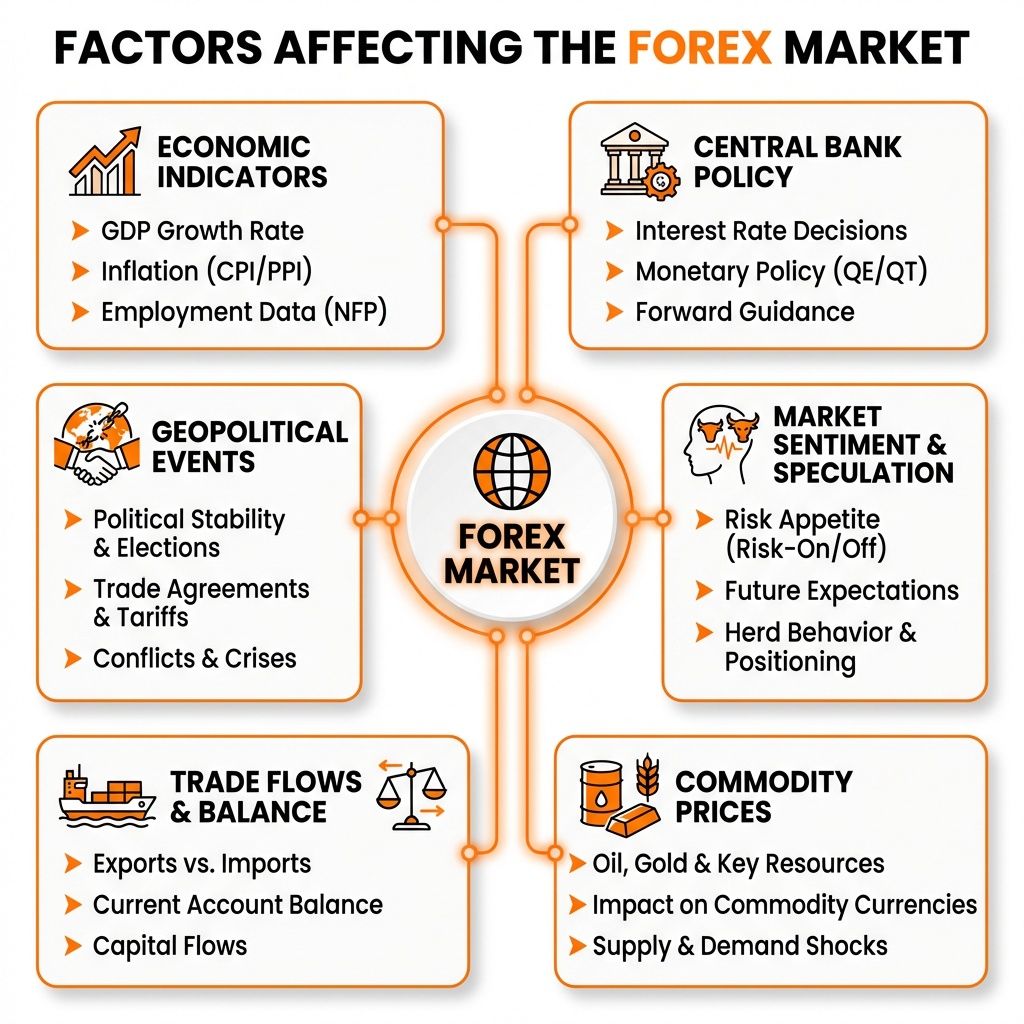
The factors affecting the forex market are diverse, interconnected, and constantly evolving. Economic indicators like interest rates, inflation, GDP, employment data, and trade balances form the fundamental foundation of currency valuation. Political stability, elections, and geopolitical tensions add layers of risk and uncertainty that can amplify or override economic factors. Central bank actions and communications directly influence currency values through monetary policy decisions and forward guidance. Market sentiment and trader psychology amplify or dampen these fundamental factors based on collective risk appetite. Global events, both scheduled and unexpected, create constant movement and trading opportunities.
Ready to apply your understanding of forex market factors to demo or live trading? Open your trading account

FAQ
Risk disclaimer: CFDs are complex instruments and come with a high risk of losing money rapidly due to leverage. You should consider whether you understand how CFDs work and whether you can afford to take the high risk of losing your money. Never deposit more than you are prepared to lose. Professional client’s losses can exceed their deposit. Please see our risk warning policy and seek independent professional advice if you do not fully understand. This information is not directed or intended for distribution to or use by residents of certain countries/jurisdictions including, but not limited to, USA & Countries included in the OFAC sanction list. The Company holds the right to alter the aforementioned list of countries at its own discretion.
TIOmarkets offers an exclusively execution-only service. The views expressed are for information purposes only. None of the content provided constitutes any form of investment advice. The comments are made available purely for educational and marketing purposes and do NOT constitute advice or investment recommendation (and should not be considered as such) and do not in any way constitute an invitation to acquire any financial instrument or product. TIOmarkets and its affiliates and consultants are not liable for any damages that may be caused by individual comments or statements by TIOmarkets analysis and assumes no liability with respect to the completeness and correctness of the content presented. The investor is solely responsible for the risk of his/her investment decisions. The analyses and comments presented do not include any consideration of your personal investment objectives, financial circumstances, or needs. The content has not been prepared in accordance with any legal requirements for financial analysis and must, therefore, be viewed by the reader as marketing information. TIOmarkets prohibits duplication or publication without explicit approval.
Join us on social media




Panagiotis is an online trading specialist with extensive experience in forex, indices, and commodities. He enjoys sharing his experience to help traders better understand global financial markets.
Related Posts