Forex Swap Fee Explained: What It Is and How It Works
BY Panagiotis Philippou
|March 26, 2026The forex swap fee is one of the most misunderstood costs in currency trading. Many traders open positions without realizing that keeping a trade open overnight can either charge or credit interest to their account.
Understanding how swap fees work is essential for anyone trading forex, especially swing traders or position traders who keep trades open for several days or weeks.
In simple terms, a forex swap fee is the interest paid or earned for holding a currency position overnight. The fee is based on the difference in interest rates between the two currencies in the pair.
This guide explains:
- what a forex swap fee is
- why swap fees exist in forex trading
- how swap fees are calculated
- examples of swap charges and credits
- how traders manage or avoid swap costs
By the end of this article, you will fully understand how swap fees impact forex trading and how to factor them into your strategy.
What Is a Forex Swap Fee?
A forex swap fee, also called a rollover fee or overnight interest, is the cost or credit applied when a trading position remains open after the end of the trading day.
In the forex market, every trade involves:
- buying one currency
- selling another currency
Because each currency has its own central bank interest rate, holding a position overnight means traders are effectively borrowing one currency while lending another.
If the currency you buy has a higher interest rate than the one you sell, you may earn interest. If the opposite occurs, you will pay a swap fee.
This interest adjustment happens automatically at the daily rollover time.
Why Swap Fees Exist in Forex Trading
To understand the necessity of swap fees, consider their origin in the interbank forex market. In this market, banks and financial institutions engage in currency trades that involve genuine borrowing and lending relationships. Consequently, any positions held open overnight incur an interest charge or credit. Retail forex brokers adopt this exact system for individual traders, meaning:
- Overnight positions result in an interest cost or gain for the trader.
- Brokers automatically adjust trader accounts every day using current swap rates.
- This daily adjustment is a direct reflection of real-world currency interest rates.
Simply put, swap fees exist because forex trading directly incorporates global monetary policy and the inherent interest rate differentials between currencies.
How Forex Swap Fees Work
Swap fees are applied when a position is rolled from one trading day to the next.
| Event | Description |
| Trade opened | Position opened during the trading day |
| Rollover time | Usually around 5 PM New York time |
| Position still open | Swap fee applied |
| Position adjusted | Swap credited or debited |
If the position is closed before rollover, no swap fee is charged.
How Forex Swap Fees Are Calculated
The forex swap fee depends on several factors.
Key factors affecting swap rates
| Factor | Impact |
| Interest rate difference | Largest influence |
| Currency pair traded | Each pair has different rates |
| Position direction | Long vs short positions |
| Trade size | Larger trades increase swap credit or debits |
The basic idea is simple:
Swap Fee = Interest Rate Difference × Position Size
In more detailed calculations, brokers use formulas based on position size, pip value, and the swap rate for the currency pair.
Example of a Forex Swap Fee
Let’s look at a simplified example.
Example trade
Currency pair: EUR/USD
Position size: 1 lot (100,000 units)
Position type: Buy
Interest rate difference: - 0.5%
If the interest rate of the euro is lower than the dollar, a trader holding the position overnight may pay interest.
Example calculation:
| Factor | Value |
| Position size | 100,000 EUR |
| Interest difference | -0.5% |
| Daily swap | -$3.20 |
This means the trader pays $3.20 per day to keep the trade open.
Over a week, that could add up to $22 or more depending on market conditions.
Positive Swap vs Negative Swap
Swap fees do not always result in a cost; sometimes traders receive interest, depending on the interest rate differential.
Positive swap
A positive swap occurs when you buy a currency with a higher interest rate and sell a currency with a lower interest rate. For example, a trader holding a long position on AUD/JPY during periods when Australia has higher interest rates may receive daily interest.
Negative swap
A negative swap occurs when the currency you buy has a lower interest rate and the currency you sell has a higher rate. In this case, traders are required to pay overnight fees.
Why Wednesday Swap Is Triple
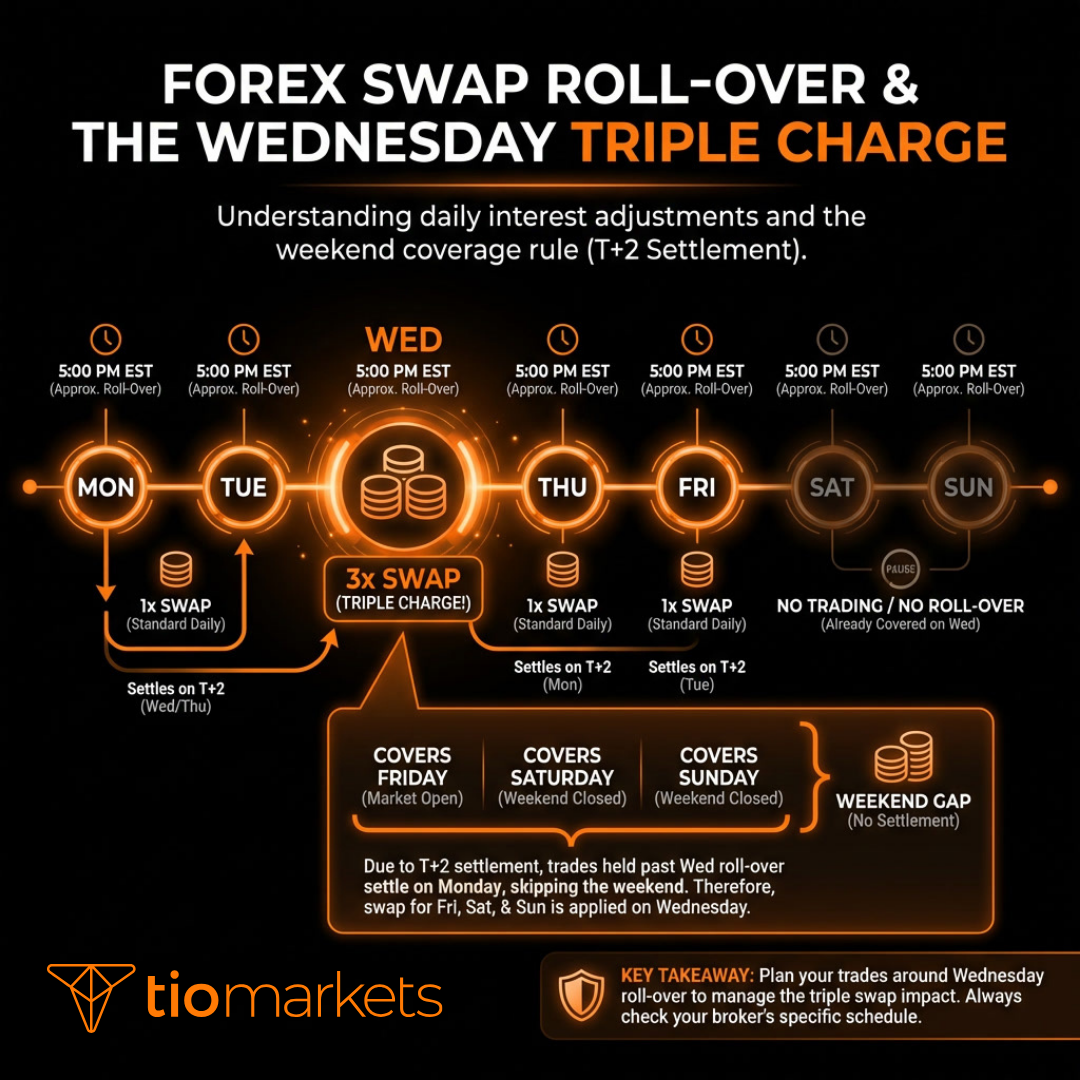
One detail that surprises many traders is the triple swap on Wednesday.
This happens because forex trades settle two business days after execution.
When positions are rolled on Wednesday night, the swap accounts for the weekend when markets are closed.
This means:
Wednesday swap = 3 × daily swap
Positions held past the daily rollover time on Wednesday incur a triple swap adjustment. This adjustment may be either a charge or a credit depending on the interest rate differential between the two currencies in the pair.
The triple swap occurs because forex trades settle two business days after execution (T+2). When a position is rolled over on Wednesday, the settlement date moves past the weekend, so the swap accounts for Friday, Saturday, and Sunday.
Forex Swap Fees and Trading Strategies
Swap fees significantly affect trading strategies because traders either pay or earn interest when positions remain open past the daily rollover time.
- Day Trading: Day traders usually avoid paying or earning swap fees entirely since their positions are typically closed before the daily rollover time.
- Swing Trading: Since swing traders may hold positions for several days, swap adjustments (which can be charges or credits) can accumulate over time.
- Position Trading: Long-term traders holding positions for weeks or months must factor in the potential for significant swap costs or credits.
Understanding how swaps work is essential when developing a trading strategy.
Carry Trade Strategy and Positive Swap
One well-known forex strategy is the carry trade.
Carry trading focuses on earning positive swap.
Traders:
- buy a high-interest currency
- sell a low-interest currency
- hold the position long term
Example pairs historically used in carry trades include:
- AUD/JPY
- NZD/JPY
- USD/TRY
Traders profit from:
- currency price movement
- daily interest income
However, this strategy carries risks if exchange rates move against the trade.
How to Check Forex Swap Rates
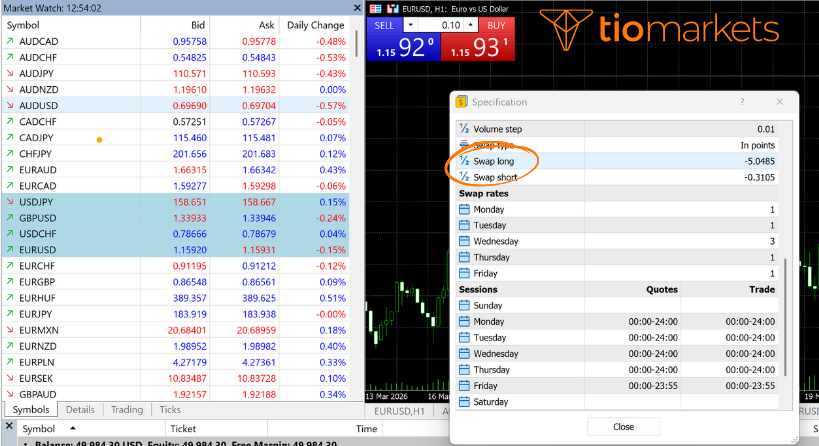
Most trading platforms display swap rates directly.
For example, in MetaTrader platforms, traders can see:
- long swap
- short swap
To view the swap rate, right click on the symbol in the Market Watch window and select Specification from the pop-up menu.
How Traders Reduce Swap Fees
Many traders actively manage swap costs.
Common approaches include:
1. Closing trades before rollover
Avoid overnight fees completely.
2. Trading swap-friendly pairs
Some pairs have smaller swap charges.
3. Using short-term strategies
Scalping and intraday trading avoid overnight fees.
4. Using swap-free accounts
Some brokers offer Islamic accounts with no overnight interest.
Swap Fees vs Other Trading Costs
Swap fees are just one of several trading costs.
Here is how they compare.
| Trading Cost | When it Applies |
| Spread | When entering or exiting a trade |
| Commision | Charged by some brokers per trade |
| Swap fee | Credited or debited when a position is held past the daily rollover time |
| Slippage | Occurs during volatile market execution |
Understanding all trading costs helps traders evaluate the true profitability of a strategy.
Forex Swap Fee Example Table
Below is a simplified illustration of how swap fees may vary across currency pairs.
| Currency Pair | Long Swap | Short Swap |
| EUR/USD | -3.5 | +1.2 |
| GBP/USD | -2.9 | +0.9 |
| AUD/JPY | +2.4 | -5.1 |
These numbers vary daily depending on interest rate changes and market conditions.
Do All Forex Trades Have Swap Fees?
No, not all forex trades incur swap fees. Swap fees are only applied when two specific conditions are met: the trade remains open past the daily rollover time and the instrument is subject to swap charges. For this reason, day traders usually never encounter these fees, as they typically close their positions before the overnight rollover.
Key Takeaways
A forex swap fee, also known as overnight interest, is the cost or credit applied when a currency position is held beyond the daily rollover time. Since the fee is based on the interest rate difference between the two currencies in the pair, positions held overnight incur either a swap charge or a credit. A crucial detail is that Wednesday swaps are typically triple, as they account for the weekend settlement. For this reason, long-term traders must carefully consider how these swap costs impact their overall strategy.
Understanding how swaps work helps traders manage costs and even identify opportunities to earn interest through carry trading. Once you are ready, you can put all you learned into action by opening an account

FAQ
Risk disclaimer: CFDs are complex instruments and come with a high risk of losing money rapidly due to leverage. You should consider whether you understand how CFDs work and whether you can afford to take the high risk of losing your money. Never deposit more than you are prepared to lose. Professional client’s losses can exceed their deposit. Please see our risk warning policy and seek independent professional advice if you do not fully understand. This information is not directed or intended for distribution to or use by residents of certain countries/jurisdictions including, but not limited to, USA & Countries included in the OFAC sanction list. The Company holds the right to alter the aforementioned list of countries at its own discretion.
TIOmarkets offers an exclusively execution-only service. The views expressed are for information purposes only. None of the content provided constitutes any form of investment advice. The comments are made available purely for educational and marketing purposes and do NOT constitute advice or investment recommendation (and should not be considered as such) and do not in any way constitute an invitation to acquire any financial instrument or product. TIOmarkets and its affiliates and consultants are not liable for any damages that may be caused by individual comments or statements by TIOmarkets analysis and assumes no liability with respect to the completeness and correctness of the content presented. The investor is solely responsible for the risk of his/her investment decisions. The analyses and comments presented do not include any consideration of your personal investment objectives, financial circumstances, or needs. The content has not been prepared in accordance with any legal requirements for financial analysis and must, therefore, be viewed by the reader as marketing information. TIOmarkets prohibits duplication or publication without explicit approval.
Join us on social media




Panagiotis is an online trading specialist with extensive experience in forex, indices, and commodities. He enjoys sharing his experience to help traders better understand global financial markets.
Related Posts