Trading Indices vs Forex: Key Differences Explained
BY Panagiotis Philippou
|March 11, 2026Trading indices vs forex is one of the most common comparisons traders make when deciding which financial market to focus on. Both markets allow traders to speculate on price movements and access global markets through CFDs, but they behave very differently.
While Forex trading involves buying and selling currency pairs such as EUR/USD, GBP/USD, and USD/JPY, indices trading focuses on the performance of a group of stocks representing a specific economy or sector. Understanding the differences between trading indices vs forex can help traders determine which market better suits their strategy, risk tolerance, and trading goals.
Trading Indices vs Forex: Understanding the Core Differences
Understanding the differences between these markets can help traders decide which one aligns best with their trading strategy, risk tolerance, and market knowledge.
In this guide, we will explore how indices and forex trading work, their key differences, and which market may be more suitable for different types of traders.
What Is Forex Trading?
Forex (foreign exchange) trading involves buying one currency while simultaneously selling another. Traders speculate on the exchange rate between two currencies, such as EUR/USD or GBP/USD.
The forex market is the largest financial market in the world, operating 24 hours a day during weekdays and involving banks, institutions, governments, and retail traders.
Currency prices move primarily due to factors such as:
- Interest rate changes
- Economic indicators
- Inflation data
- Geopolitical events
- Central bank policy
Because currencies respond quickly to global economic developments, the forex market can experience frequent price fluctuations and high trading activity.
Forex markets are often divided into three major trading sessions: the Asian session, the European session, and the North American session. Each session brings different levels of market activity and liquidity depending on which financial centers are open. For example, EUR/USD often sees higher trading volume during the London and New York sessions when both European and U.S. participants are active. Understanding these session overlaps can help traders identify periods of higher volatility and increased trading opportunities when trading indices vs forex markets.
What Is Indices Trading?
Indices trading involves speculating on the price movements of a stock market index rather than individual companies.
A stock index measures the performance of a group of companies that represent a specific market or sector.
Examples of major global indices include:
- S&P 500 – Tracks 500 large U.S. companies
- NASDAQ 100 – Focuses on major technology companies
- FTSE 100 – Represents the largest companies on the London Stock Exchange
- DAX 40 – Tracks major German companies
Instead of trading individual stocks, traders speculate on whether the overall index value will rise or fall.
This allows traders to gain exposure to the broader economic performance of a region or sector.
Because stock indices reflect the performance of multiple companies, they are often used by traders as a way to gauge overall economic sentiment. For example, when economic conditions are strong, major indices such as the S&P 500 or DAX may trend upward as corporate earnings improve and investor confidence grows. Conversely, during economic uncertainty or recessions, indices may decline as investors reduce risk exposure. This broader economic connection is one reason many traders compare trading indices vs forex when deciding which market better fits their trading style.
Trading Indices vs Forex: Key Differences
Although both markets are popular among retail traders, several important differences exist.
1. Underlying Asset
When comparing trading indices vs forex, the most fundamental difference lies in what is being traded.
Forex trading
- Involves currency pairs
- Based on exchange rates between two economies
Indices trading
- Represents a group of stocks
- Reflects the overall performance of a market or sector
In simple terms, forex trading focuses on currencies, while indices trading focuses on stock market performance.
2. Market Drivers
Another important factor when comparing trading indices vs forex is what actually drives price movements in each market.
Forex drivers
Currency markets are strongly influenced by macroeconomic factors such as:
- Interest rates
- Inflation
- employment data
- central bank policies
Economic announcements and geopolitical developments can quickly impact currency prices.
Indices drivers
Stock indices are influenced by factors including:
- corporate earnings
- economic growth
- industry performance
- investor sentiment
Because indices reflect multiple companies, they often move in response to overall economic conditions rather than single events.
3. Volatility
Volatility refers to how quickly and how much prices move.
Forex markets can experience rapid price changes because currency values react instantly to economic news, geopolitical events, and economic data releases. These price fluctuations are often referred to as market volatility.
Indices, however, represent a basket of stocks, which can sometimes smooth out price movements. This diversification means that indices may behave differently from individual stocks or currencies.
However, during periods of market uncertainty or economic stress, indices can experience significant volatility as well.
It is also worth noting that volatility patterns can differ significantly between these markets. Forex volatility is often driven by scheduled economic announcements such as central bank interest rate decisions, inflation reports, and employment data releases. Indices volatility, however, may be influenced more by corporate earnings seasons, economic growth expectations, and broader investor sentiment. Traders who understand these volatility patterns may be better prepared when evaluating trading indices vs forex strategies.
4. Market Liquidity
Liquidity refers to how easily traders can enter or exit positions without significantly affecting the price.
The forex market is considered the most liquid financial market globally, with massive daily trading volume and constant participation from financial institutions and traders worldwide.
Because of this high liquidity:
- spreads are often tight
- large orders can be executed quickly
- market activity remains consistent throughout the trading day
Indices trading also has strong liquidity, particularly for major indices such as the S&P 500 or NASDAQ, but it generally does not match the scale of the global forex market.
High liquidity in the forex market also contributes to relatively stable spreads and efficient price execution. Major currency pairs such as EUR/USD or USD/JPY often experience consistent trading volume throughout the global trading day. While major stock indices also have strong liquidity, their activity can fluctuate more depending on the opening and closing hours of the underlying stock exchanges. This difference in liquidity structure is another factor traders consider when comparing indices trading vs forex.
5. Market Hours
Forex markets operate 24 hours a day, five days a week.
Trading sessions move across major financial centers:
- Sydney
- Tokyo
- London
- New York
This continuous activity allows traders to participate at nearly any time during the week.
Indices trading, however, is often tied to the operating hours of the underlying stock exchange.
For example:
- U.S. indices follow the New York trading session
- European indices align with European exchanges
While some brokers offer extended trading hours for indices, liquidity is typically highest during the main market session.
6. Number of Trading Opportunities
Forex trading focuses on currency pairs.
These are generally grouped into:
- Major pairs (EUR/USD, USD/JPY)
- Minor pairs
- Exotic pairs
Although there are many currency pairs available, most trading volume is concentrated in a small group of major pairs.
Indices trading, on the other hand, offers exposure to many global stock markets.
Examples include:
- U.S. indices
- European indices
- Asian indices
- sector-specific indices
This broader selection allows traders to speculate on different economies and industries.
Trading Strategies for Indices vs Forex
Although many technical analysis tools can be used across both markets, trading strategies may differ slightly between forex and indices trading. Forex traders often focus on macroeconomic data, interest rate expectations, and currency correlations when developing strategies. In contrast, indices traders may pay closer attention to broader economic trends, sector performance, and investor sentiment across equity markets.
Some traders prefer forex because of the consistent liquidity and frequent price movements in major currency pairs. Others prefer indices trading because market trends can sometimes be clearer during strong economic cycles. Understanding these strategic differences can help traders evaluate trading indices vs forex opportunities more effectively.
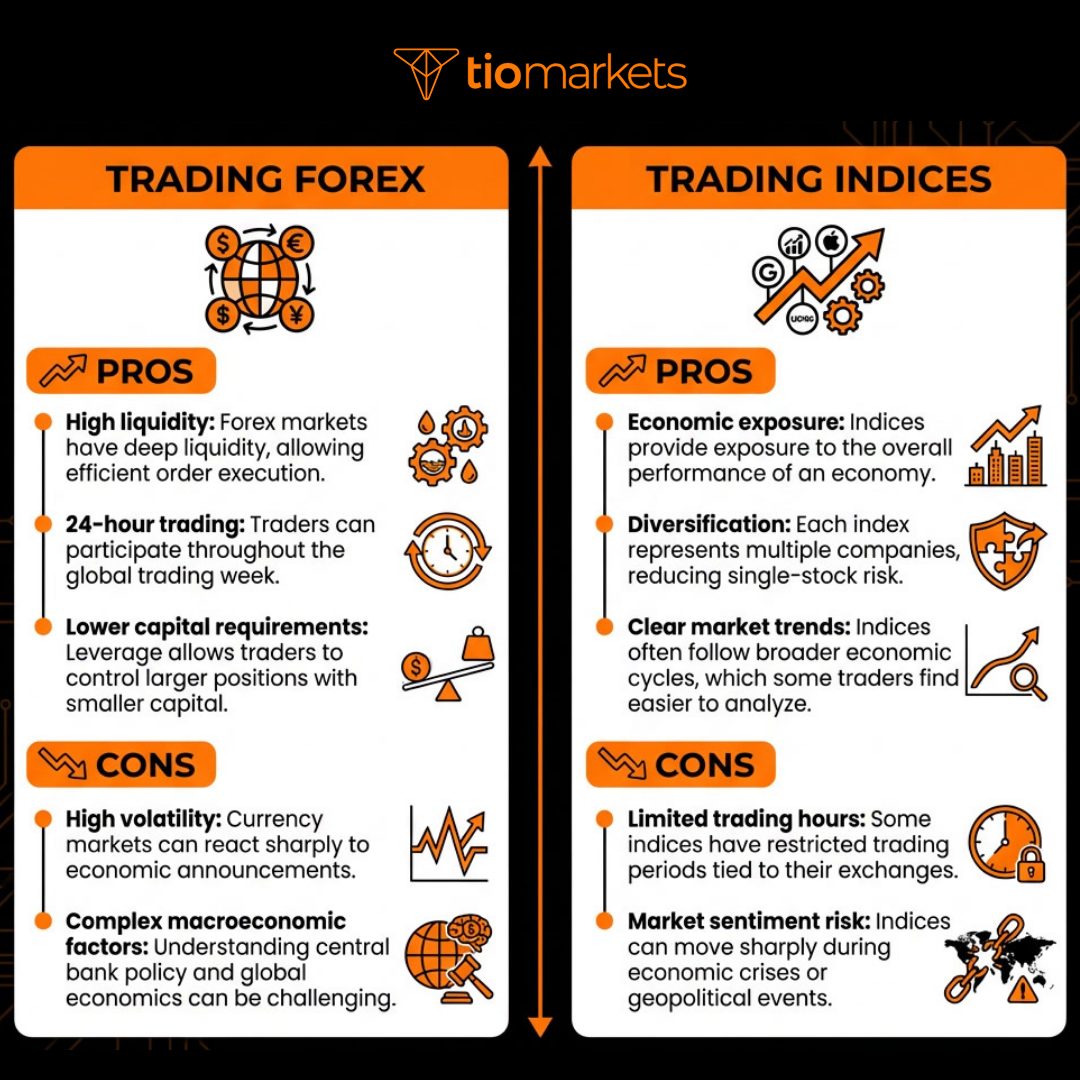
Pros and Cons of Trading Forex
Advantages
- High liquidity: Forex markets have deep liquidity, allowing efficient order execution.
- 24-hour trading: Traders can participate throughout the global trading week.
Lower capital requirements: Leverage allows traders to control larger positions with smaller capital.
Disadvantages
- High volatility: Currency markets can react sharply to economic announcements.
- Complex macroeconomic factors: Understanding central bank policy and global economics can be challenging.
Pros and Cons of Trading Indices
Advantages
- Economic exposure: Indices provide exposure to the overall performance of an economy.
- Diversification: Each index represents multiple companies, reducing single-stock risk.
- Clear market trends: Indices often follow broader economic cycles, which some traders find easier to analyze.
Disadvantages
- Limited trading hours: Some indices have restricted trading periods tied to their exchanges.
- Market sentiment risk: Indices can move sharply during economic crises or geopolitical events.
Which Market Is Better for Beginners?
There is no universal answer to whether forex or indices trading is better.
Each market suits different trading styles.
Forex trading may suit traders who:
- enjoy analyzing economic data
- prefer highly liquid markets
- trade frequently during multiple sessions
Indices trading may appeal to traders who:
- prefer analyzing broader economic trends
- want exposure to stock market performance
- focus on major macroeconomic movements.
In many cases, traders eventually diversify and trade both markets.
Trading Indices and Forex Using CFDs
Many traders access both markets through Contracts for Difference (CFDs).
CFDs allow traders to speculate on price movements without owning the underlying asset. Many traders also use leverage to increase their market exposure.With CFDs, traders can:
- open long or short positions
- use leverage
- access global markets from a single platform.
However, leverage increases both potential profits and losses, making risk management essential.
Another important consideration when comparing trading indices vs forex is diversification. Some traders choose not to limit themselves to a single market. Instead, they trade both asset classes depending on market conditions. For example, a trader may focus on forex during major central bank announcements and shift attention to indices during earnings seasons or periods of strong stock market momentum. Diversifying across markets can provide additional opportunities while spreading exposure across different economic drivers.
Final Thoughts
Trading indices vs forex ultimately comes down to a trader’s preferred market structure, strategy, and risk tolerance.
Forex trading focuses on currency exchange rates and is heavily influenced by macroeconomic data and central bank policy.
Indices trading reflects the performance of stock markets and broader economic conditions.
Rather than choosing one market over the other, many traders explore both instruments and incorporate them into a diversified trading strategy.
Understanding how each market behaves can help traders make more informed decisions and align their trading approach with their financial goals.
Whether you choose to focus on forex markets, stock indices, or both, understanding how each market behaves is essential for building a trading strategy. Traders who want to explore global markets can open a trading account and access multiple asset classes including forex, indices, commodities, and more from a single platform.

FAQ
Risk disclaimer: CFDs are complex instruments and come with a high risk of losing money rapidly due to leverage. You should consider whether you understand how CFDs work and whether you can afford to take the high risk of losing your money. Never deposit more than you are prepared to lose. Professional client’s losses can exceed their deposit. Please see our risk warning policy and seek independent professional advice if you do not fully understand. This information is not directed or intended for distribution to or use by residents of certain countries/jurisdictions including, but not limited to, USA & Countries included in the OFAC sanction list. The Company holds the right to alter the aforementioned list of countries at its own discretion.
TIOmarkets offers an exclusively execution-only service. The views expressed are for information purposes only. None of the content provided constitutes any form of investment advice. The comments are made available purely for educational and marketing purposes and do NOT constitute advice or investment recommendation (and should not be considered as such) and do not in any way constitute an invitation to acquire any financial instrument or product. TIOmarkets and its affiliates and consultants are not liable for any damages that may be caused by individual comments or statements by TIOmarkets analysis and assumes no liability with respect to the completeness and correctness of the content presented. The investor is solely responsible for the risk of his/her investment decisions. The analyses and comments presented do not include any consideration of your personal investment objectives, financial circumstances, or needs. The content has not been prepared in accordance with any legal requirements for financial analysis and must, therefore, be viewed by the reader as marketing information. TIOmarkets prohibits duplication or publication without explicit approval.
Join us on social media




Panagiotis is an online trading specialist with extensive experience in forex, indices, and commodities. He enjoys sharing his experience to help traders better understand global financial markets.
Related Posts