EUR/USD Forecast for the Week of 6th April 2026
BY TIOmarkets
|April 6, 2026EUR/USD Market Overview
EUR/USD is starting the week of 6-10 April 2026 trading near 1.1520, sustaining the quiet consolidation atmosphere as last week's Nonfarm Payrolls release volatility has already been absorbed.
During last week, after the slight downward correction of the pair on the back of the recent NFP release, it has successfully maintained above the 1.1500 support area, implying that the selling pressure has diminished.
Even with the most recent depreciation, the bigger pattern is quite positive. EUR/USD is not only trading in a medium-to-long term bullish trend but also working through what is classically interpreted as a technical retracement rather than a major reversal of the trend.
The short-term market volatility stays high as investors absorb the recent US labor data and shift their attention somewhat towards the upcoming inflation and business indicators, which will give them a more complete picture of the economy.
Major events affecting currency trading include:
- Reevaluation of US labor market robustness after NFP
- Heavy focus on US inflation and economic growth numbers
- Consistency but modest changes to the Eurozone inflation trends
- Continued policy divergence between Fed and ECB
These elements, in combination, are leading to a slightly bear-biased neutral consolidation position. Meanwhile, traders remain on standby for new macroeconomic stimuli to provide the impetus for further moves.
For the moment, the EUR/USD pair is still stuck in the trading range with little commitment to direction after the sharp data release last week.
EUR/USD Technical Analysis
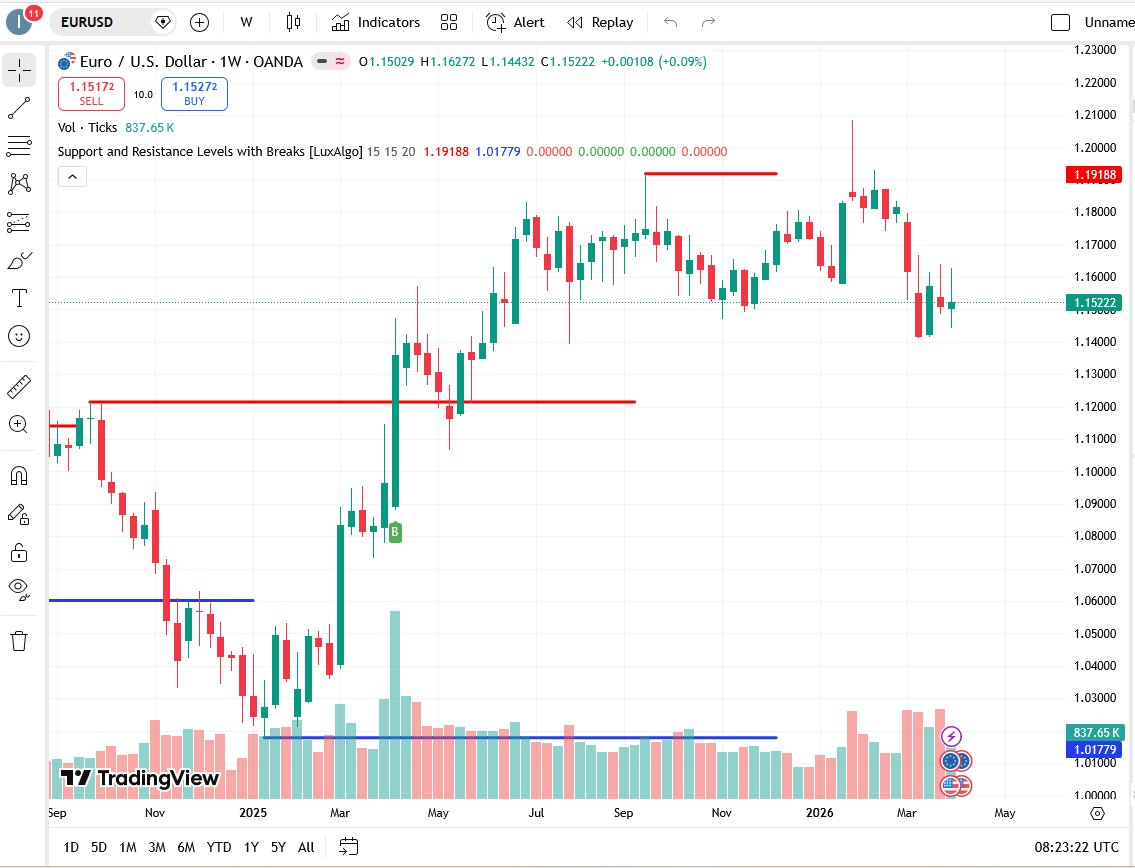
Current Market Structure
Even though the weekly chart shows the EUR/USD remains in a bullish trend. with momentum deterioration indicating a short-term weakening.
The movement from around the 1.1650 down to 1.1500 shows the retracement component of an impulse wave.
Looking at the immediate future, the price action has more downside potential, but at the same time, it appears to be recovering from the recent sell-off, ensuring indirect easing of downward pressure.
Nevertheless, the losses are quite limited, and the main structure has not been violated by a strong enough move to indicate a turning point in the trend yet, so the correction is deemed still orderly.
Moving Averages
The present setup of moving averages further confirms the expectation of a brief pause in the rally.
- 20-period MA: At around 1.1620(below price, which is short-term resistance)
- 50-period MA: Around 1.1525 (a crucial pivot point)
- 100-period MA: Around 1.1320
- 200-period MA: Around 1.1180
This arrangement indicates the correction period is not indefinite, as the main structure is still bullish.
The 50-period moving average close to 1.1525 is still the key technical level for the current market situation.
Momentum Indicators
Indicators of momentum illustrate a range bound to a downtrend situation. RSI is trading a little lower than the middle 50, which reflects less bullish momentum. MACD is also below zero level, a sign of short-term difficulties.
However, after the almost oversold levels, the oscillators are coming closer to reasonably flat, which opens the way for short-term consolidations or corrections. Taken together, the momentum signals suggest that the market does not have a clear direction and is likely to be in a consolidation phase.
Key Support and Resistance Levels
Here are the major technical levels that we will be watching this week.
Resistance Levels
- 1.1550: First line of resistance
- 1.1600: Main resistance line
- 1.1620–1.1660: Significant resistance area
- 1.1700: Top resistance
Support Levels
- 1.1500: Psychological point
- 1.1450: Major support structure
- 1.1400: The next support level
- 1.1300: Medium-term support
Provided EUR/USD does not break out of the 1.1450 and 1.1600 range, the market is very likely to continue trading in range-bound conditions.
Bullish Scenario
The cooperation/participation of the bulls in the market can be considered if EUR/USD is able to not only hold consolidations from the levels of 1.1500 but also start to show signs of upward momentum.
Crossing above 1.1600 would be the first technical indication that the uptrend is continuing.
The target would be
- 1.1650
- 1.1700
This move could be a reaction to relatively weak US economic data post NFP which might make market participants anticipate that the Fed will adopt a more accommodative stance.
On the other hand, the eurozone inflation being at a moderate level could be the reason why the expectations of the ECB continuing with a restrictive stance remain intact.
In this case, EUR/USD would have the potential to reach the upper end of the range.
Bearish Scenario
The bearish scenario becomes more plausible should the EUR/USD not only fail to keep 1.1500 but also make a decisive breaking of 1.1450.
Further moves down in the same direction can be expected:
- 1.1400
- 1.1300
It is worth noting that this may be a result of US data strengthening, which could in turn escalate the expectations that the Federal Reserve will keep interest rates at high levels for an extended period.
Labor market strengthening and the overall convincing economic indicators would increase the US dollar's strength, putting downward pressure on EUR/USD.
In fact, in times of global risk-off, USD holds up strongly, which is detrimental for the pair.
But all this, by and large, is still consistent with the bigger trend keeping its more bullish stance as long as prices are above 1.1300.
EUR/USD Fundamental Drivers
There are a few macroeconomic factors contributing to the EUR/USD outlook for the week. The following are the most important ones:
United States Economic Data
The US economic indicators calendar will be scrutinized very closely this week, and especially after the major release of NFP last week. The major focus will be on confirmation of the US economy’s resilience through the release of further data.
The latest releases in data show a mixed but resilient overall economic environment. The industrial sectors, particularly ISM Services, have been bullish; hence the US economy is still on the path of moderate growth.
At the same time, labor force aspects remain under the microscope, as market participants need to understand whether the employment situation is stabilizing or weakening.
Data releases this week will come with a lot of weight. ISM indexes alongside consumer data will be watched closely to help the market determine whether economic momentum is holding or whether the first signs of deceleration are evident.
More robust improvements in the economy would be USD-positive, while disappointments might create selling pressure.
Federal Reserve Expectations
Between rate hikes and cuts, the markets are trying to manage time and balance. The Fed gathers data and continues to observe inflation and employment before making a decision.
If data suggests the economy is doing well, then a risk of rate cuts will be pushed back, supporting the USD. In contrast, bad data will cause the market to increase the expectation of easing, putting downward pressure on the dollar.
Eurozone Inflation
Inflation in the eurozone is steady, but it is not significantly beyond the target. The latest numbers indicate that the price increases are easing but not significantly enough for rapid rollbacks to be justified.
Consequently, the European Central Bank might keep its cautious stance and still hold the restrictive policy while keeping the growth risks under review. If prices stay stable, then the euro will not be under pressure even if the economy is not the strongest.
Policy Divergence
Monetary policy divergence remains the fundamental driver for the EUR/USD pair. Currently, the Fed is backed by the better data, but the ECB is dealing with weaker growth.
This goes well with the short-term USD outlook, but the long term looks more balanced.
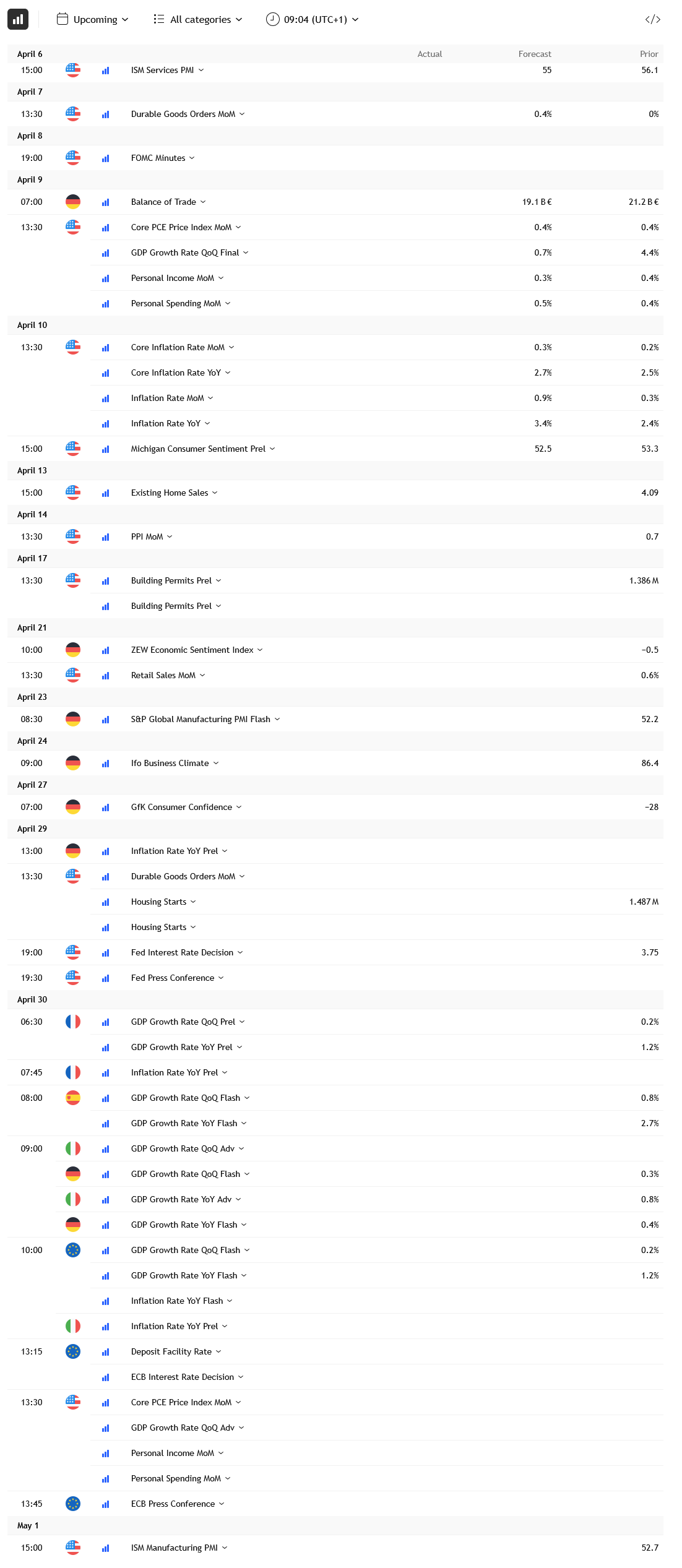
This Week’s EUR/USD High-Impact Events
There is a number of economic developments that could cause movements in EUR/USD this week.
United States
- ISM Manufacturing PMI: The index measures manufacturing activity and the level of economic momentum.
- ISM Services PMI: The services sector is the largest portion of the US economy, so this index is vital to its health.
- Retail-Related Indicators: Show trends in consumer demand and hence reflect the strength of the economy.
Eurozone
- Fresh Inflation Numbers for the Eurozone: Continued price rises remain very significant for the ECB's future monetary policy moves.
- Inflation Reports for Eurozone Countries: Offer deeper insights into the price trends in major countries like Germany and France.
Central Bank Communication
- Federal Reserve Speeches: Statements by Fed members might change market expectations for the timing and size of interest rate changes.
- ECB Speeches: Words by ECB officials may affect the overall euro sentiment.
Risk Considerations for EUR/USD This Week
Several factors could cause the EUR/USD to move sharply and unpredictably in either direction.
Macro surprises remain the main risk factor, especially with the data releases following the NFP. Central Bank talk plays a big role in the setting and changing of rate expectations. Perceptions of global risk will remain pertinent with the USD being the safe haven currency during turbulent times. Lastly, technically, any breaks from last week's 1.1450–1.1600 range will be closely watched. A strong move out of this range could lead to a big directional move.

Risk disclaimer: CFDs are complex instruments and come with a high risk of losing money rapidly due to leverage. You should consider whether you understand how CFDs work and whether you can afford to take the high risk of losing your money. Never deposit more than you are prepared to lose. Professional client’s losses can exceed their deposit. Please see our risk warning policy and seek independent professional advice if you do not fully understand. This information is not directed or intended for distribution to or use by residents of certain countries/jurisdictions including, but not limited to, USA & Countries included in the OFAC sanction list. The Company holds the right to alter the aforementioned list of countries at its own discretion.
TIOmarkets offers an exclusively execution-only service. The views expressed are for information purposes only. None of the content provided constitutes any form of investment advice. The comments are made available purely for educational and marketing purposes and do NOT constitute advice or investment recommendation (and should not be considered as such) and do not in any way constitute an invitation to acquire any financial instrument or product. TIOmarkets and its affiliates and consultants are not liable for any damages that may be caused by individual comments or statements by TIOmarkets analysis and assumes no liability with respect to the completeness and correctness of the content presented. The investor is solely responsible for the risk of his/her investment decisions. The analyses and comments presented do not include any consideration of your personal investment objectives, financial circumstances, or needs. The content has not been prepared in accordance with any legal requirements for financial analysis and must, therefore, be viewed by the reader as marketing information. TIOmarkets prohibits duplication or publication without explicit approval.
Join us on social media




Behind every blog post lies the combined experience of the people working at TIOmarkets. We are a team of dedicated industry professionals and financial markets enthusiasts committed to providing you with trading education and financial markets commentary. Our goal is to help empower you with the knowledge you need to trade in the markets effectively.
Related Posts