EURUSD Forecast for the Week of 16th March 2026
BY TIOmarkets
|March 16, 2026EURUSD Market Overview
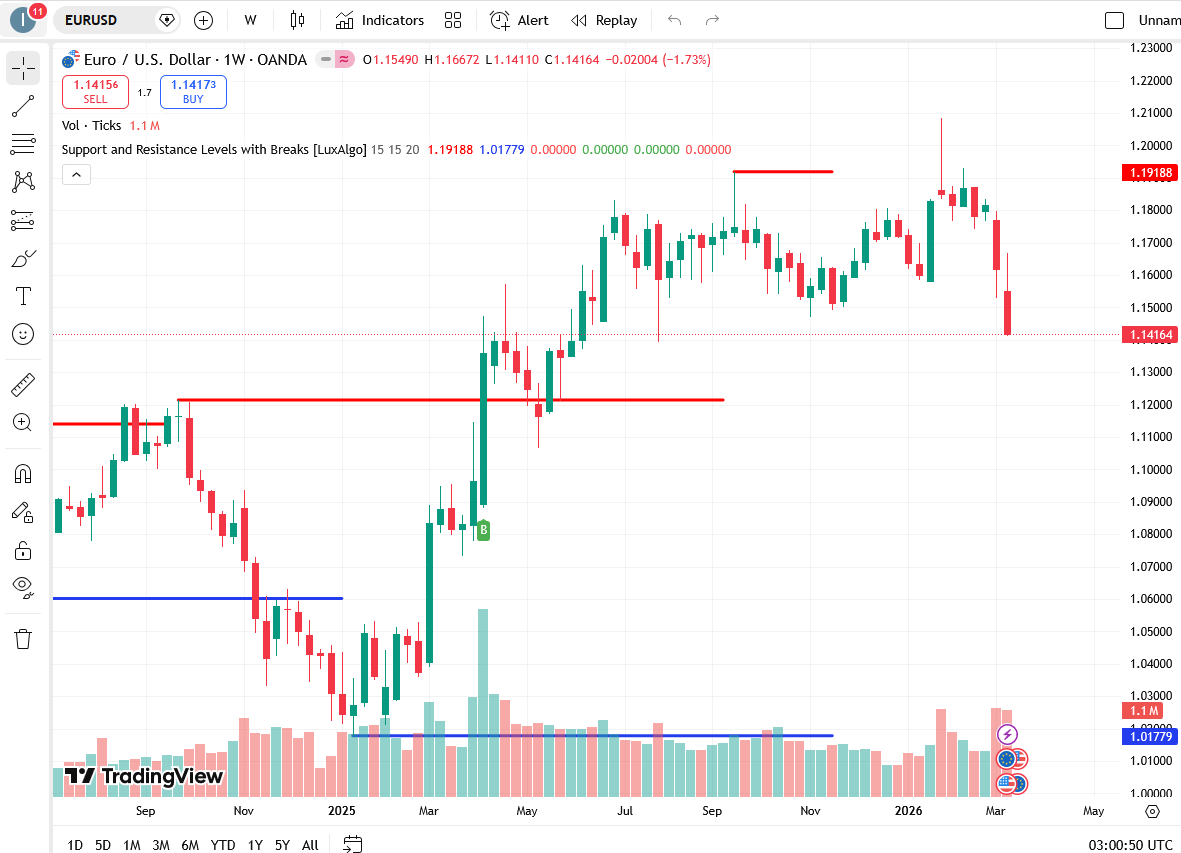
This week starting 16-20 March 2026, EUR/USD is hovering around the 1.1416 level after the preceding broad appreciation cycle earlier in the year. The pair, assisted by the US dollar, which picked up safe-haven flows, has increasingly adopted a more defensive short-term structure due to ongoing global energy market uncertainties and geopolitical developments.
Besides this, the dollar has also been able to maintain its strength due to the U.S. monetary policy expectation repricing. Inflation data in the U.S. have not been dropping as fast as some investors expected earlier, thereby strengthening the belief that the Fed may remain cautious with policy easing. Consequently, U.S. bond yields have stayed quite solid relative to those of other major economies.
On the other hand, the euro has been put under extra selling pressure due to the eurozone's vulnerability to rising energy prices. The higher energy prices can directly impact European economic conditions more severely than those of the U.S., which is likely to be a disadvantage factor for the region's growth and may also cause more volatility of the single currency.
EUR/USD, despite the current pullback, is still above its long-term support zones
This is retracement of the larger medium-term uptrend rather than an outright reversal. In the near future, however, sentiment in the market seems to be going towards caution with traders getting ready for a really important week in terms of global monetary policy.
There are two international monetary policy meetings which overshadow the macroeconomic event calendar: the Federal Reserve meeting on 17-18 March and the European Central Bank meeting on 19 March. They are probably going to have a major influence on the market's expectations and may induce drastic changes in the currency markets.
Technical Analysis for EURUSD
Current Market Structure
Technically speaking, EUR/USD has a negative short-term bias. The pair dropped from the highs it reached recently and is currently consolidating at a level close to the 1.1400 psychological level, which seems to be an important support zone in the short term.
The analysis of price data also reveals that the pair is trading below several short-term moving averages, which shows that selling momentum is still strong at least in the short term. However, the pair remains above longer-term trend indicators which points out that the overall market structure has not turned down fully yet.
This kind of setup typically corresponds to a situation when the market has run out of its upward impetus but at the same time has not shifted into a substantial downward trend. The pair is likely to continue its correction phase characterized by volatile price swings and temporary rebounds.
Moving Averages and Trend Structure
What the technical picture at present reveals is a sharp disconnect of short-term from long-term trend clues.
Short period averages such as the 10, 20, and 30 period moving averages are all currently situated above price levels being considered and hence act as a resistance to any upward correction. This situation further supports the idea that short-term momentum is still governed by sellers.
In parallel, the 100- and 200-period moving averages continue to be located underneath the price band, thus offering a structural support platform for the pair. As long as EUR/USD
remains above this long-term support section, the larger bullish picture that has been built since the beginning of the year is still technically valid.
Positionally speaking, the 1.1500 level is significant as it not only coincides with the region around the 50-period moving average but also acts as the top limit of the corrective range.
Momentum Indicators
Momemtum indicators only suggest that bulls are losing steam rather than that bears are taking charge aggressively.
The Relative Strength Index (RSI) being under the
neutral 50 level shows that, actually, selling momentum has been predominant in recent days. On the other hand
the indicator is nowhere near the oversold level so that the pair can still oscillate to some extent.
The MACD indicator still focuses on the negative side of things on the daily chart
which tells us that there is still some room in this correction phase. And at the same time, momentum indicators
gradually becoming less steeply sloped are simply testing whether the strength of selling pressure is dissipating.
Stochastics in particular are nearing oversold levels, which can increase the likelihood that there will be small short-term rebound in price,
although the overall mood will continue to be one of caution.
Key Support and Resistance Levels
Some key levels are as follows and they may be very useful in predicting the direction of EUR/USD this week.
Resistance Levels
- 1.1450 - nearest resistance and first recovery barrier
- 1.1500 - major psychological resistance and short-term trend change point
- 1.1600 - very strong resistance level that would indicate an extensive recovery
- 1.1700 - top resistance zone and safeguard for previous consolidation
- 1.1750 - stretched resistance in case of strong upside momentum
Support Levels
- 1.1400 - first line of psychological support level
- 1.1300 - main support zone significantly lower than current range
- 1.1250 - auxiliary support if selling pressure intensifies
- 1.1200 - medium-term structural support level
- 1.1100 - deeper technical support and long-term retracement zone
Next week the main battle area between buyers and sellers will most likely be the range of 1.1400 to 1.1500.
Bullish Scenario
A bullish bounce from the 1.1400 support level that results in EUR/USD picking up its pace early in the week may be the winning ticket for the bulls.
In line with that, the first obstacle for the bulls would be the 1.1450 resistance level. Should they manage to get over it fairly comfortably, the 1.1500 psychological level will be the next hurdle as it plays a significant role as a technical barrier. Once above 1.1500 with continuing strength in bullish sentiment, the pair could look for further upside targets towards the levels of 1.1600 and 1.1700.
For such an achievement, the macroenvironment would have to give the bulls some encouragement in the form of Fed dovishness, for example. A Fed signaling that it is likely to keep policy unchanged for some time will cause a reduction of market expectations for a longer restrictive policy while ECB dovishness may help to further support the Euro.
At the same time, a strong breakout on the upside would be unlikely without the fundamental reasons that
justify it particularly given the upcoming central bank meetings.
Bearish Scenario
EUR/USD will keep the bearish setup intact as long as it fails to break above the 1.1500 resistance zone.
In the event that the pair does not manage to break back above 1.1450 and fresh selling drives price down through 1.1400, the result could be an accelerated downward movement
towards 1.1300 which is the next major support level. Breaking below 1.1300 would likely open the pair up for further falls to 1.1250 and 1.1200
levels which coincide with long-term supports, which can attract renewed buying.
Bearish scenario may become a reality if the Fed emphasizes their commitment to restrictive policies whereas if ECB expresses more concerns about economic growth, the Euro may remain under pressure.
In such a macro environment dollar strength combined with weaker euro sentiment may lead to
strengthening the correction trend in EUR/USD
EURUSD Fundamental Drivers
Federal Reserve Policy Expectations
Currency markets will be mainly impacted by the Fed meeting on 17, 18 March.
Apart from the policy decision itself, much attention will be paid to the updated economic projections and the guidance about the future path of interest rates. Increasing inflation risks will sustain the audience's Fed expectation that restrictive conditions may be maintained at a higher level for a longer period than previously anticipated.
This is likely to give support to the US dollar.
ECB Monetary Policy Outlook
The ECB meeting on 19 March will be somewhat equally consequential for the euro.
The ECB has a difficult balance to strike. Inflation pressures remain however, economic growth in the eurozone has not been consistent. Policymakers have to take into account the possibility that tightening too aggressively may result in unnecessarily severe financial conditions.
The members of the market will be looking for the ECB press statement and they will be careful to analyze the language that could be interpreted as a signal about the direction of future policy.
Inflation Trends
Inflation is the key issue for EUR/USD going forward.
Latest figures in the U.S. and euro area indicate that inflation is slowly trending down, although it is still beyond central bank targets. It is the perfect ground for speculations about the timing of future policy moves as it increases the impact of economic data releases also.
Global Risk Sentiment
Such consideration is not just limited to a direct impact on the currency pair but also considers changes in the market's risk appetite. Oftentimes, geopolitical tensions or rising energy prices lead to an increased demand for the US dollar.
As a global reserve currency, the USD is often seen as the "safe haven." Better market sentiment can even support the euro because investors go for higher yielding assets.
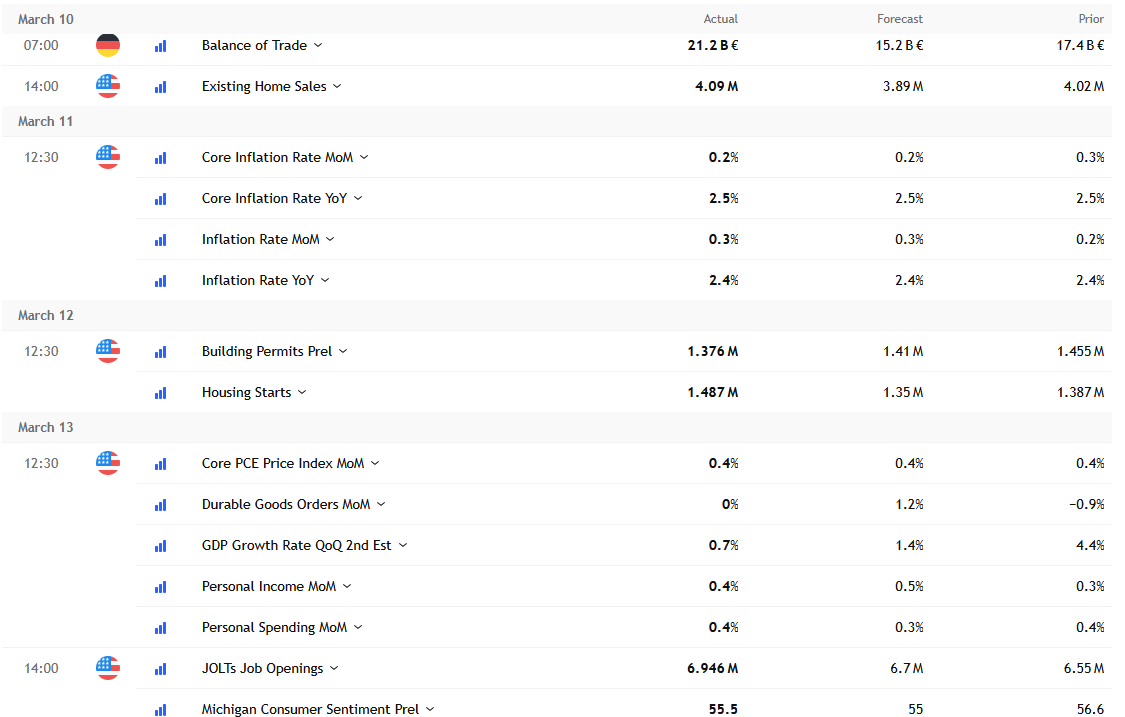
This Week's EURUSD High Impact Events
- FOMC Interest Rate Decision: Federal Reserve's update on policy and projections will be a major event for USD strength.
- Federal Reserve Press Conference: Fed Chair's words and tone
- ECB Interest Rate Decision: Policymakers’ assessment of inflation risks in the eurozone
- ECB Press Conference: Comments by ECB leadership could set the tone of eurozone interest rates in the future and influence the euro.
Eurozone Inflation Data Releases: May change expectations about how long the ECB will keep restrictive policy environments.
Risk Considerations for EURUSD This Week
There are a number of risk factors that may have an impact on EUR/USD price movements.
First of all, central bank communication risk is heightened as the Federal Reserve and ECB meetings are very close. The market might be more volatile reacting to the guidance rather than the decisions. Second, macroeconomic volatility is a factor to consider. Sudden economic data or changes in inflation expectations may cause rapid price moves. Third, geopolitical developments and rising energy prices may affect sentiment. The eurozone economically will suffer more from the increase in energy prices and thus the pressure on the euro may intensify. Last, technical breakout risk should also be taken into consideration. A decisive move outside the 1.1400, 1.1500 range could trigger momentum trading and amplify volatility.

Risk disclaimer: CFDs are complex instruments and come with a high risk of losing money rapidly due to leverage. You should consider whether you understand how CFDs work and whether you can afford to take the high risk of losing your money. Never deposit more than you are prepared to lose. Professional client’s losses can exceed their deposit. Please see our risk warning policy and seek independent professional advice if you do not fully understand. This information is not directed or intended for distribution to or use by residents of certain countries/jurisdictions including, but not limited to, USA & Countries included in the OFAC sanction list. The Company holds the right to alter the aforementioned list of countries at its own discretion.
TIOmarkets offers an exclusively execution-only service. The views expressed are for information purposes only. None of the content provided constitutes any form of investment advice. The comments are made available purely for educational and marketing purposes and do NOT constitute advice or investment recommendation (and should not be considered as such) and do not in any way constitute an invitation to acquire any financial instrument or product. TIOmarkets and its affiliates and consultants are not liable for any damages that may be caused by individual comments or statements by TIOmarkets analysis and assumes no liability with respect to the completeness and correctness of the content presented. The investor is solely responsible for the risk of his/her investment decisions. The analyses and comments presented do not include any consideration of your personal investment objectives, financial circumstances, or needs. The content has not been prepared in accordance with any legal requirements for financial analysis and must, therefore, be viewed by the reader as marketing information. TIOmarkets prohibits duplication or publication without explicit approval.
Join us on social media




Behind every blog post lies the combined experience of the people working at TIOmarkets. We are a team of dedicated industry professionals and financial markets enthusiasts committed to providing you with trading education and financial markets commentary. Our goal is to help empower you with the knowledge you need to trade in the markets effectively.
Related Posts