GBP/USD Forecast for the Week of 9th March 2026
BY TIOmarkets
|March 9, 2026GBP/USD Market Overview
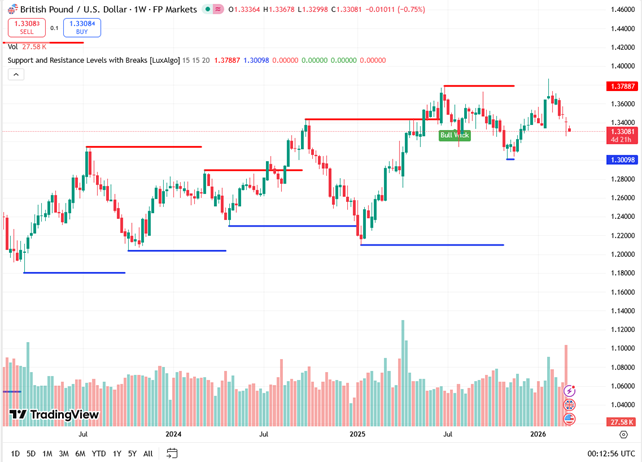
The GBP/USD pair begins the week of 9th March 2026 trading near 1.3311, following a modest pullback from the recent highs reached earlier this year. The pair has entered a short-term corrective phase after a period of steady appreciation, as the market reassesses macroeconomic conditions and expectations for monetary policy in both the United States and the United Kingdom.
Despite the recent retracement, the broader structure of the market still appears relatively constructive. GBP/USD remains above its longer-term moving averages, suggesting that the medium-term trend that developed earlier in the year has not yet been invalidated. However, the recent decline below short-term moving averages indicates that near-term momentum has shifted slightly in favor of the US dollar.
The 1.3300 area has emerged as an important equilibrium zone for the market. Price action around this level reflects the current balance between dollar strength, driven by expectations surrounding Federal Reserve policy, and underlying support for the pound.
Looking ahead, the direction of GBP/USD during the week is likely to be heavily influenced by major US macroeconomic data releases and Federal Reserve communication. In the absence of significant UK economic events, movements in the pair may largely reflect shifts in US interest rate expectations and global risk sentiment.
Technical Analysis for GBP/USD
Current Price Structure
From a technical perspective, GBP/USD is currently moving within a short-term corrective structure after failing to sustain its earlier bullish momentum.
The pair is trading below short-term moving averages such as the 10- and 50-day averages, which indicates that short-term sentiment has turned somewhat negative. However, the price remains above longer-term moving averages such as the 100- and 200-day averages, which suggests that the broader trend still retains a constructive bias.
This configuration often reflects a market that is undergoing consolidation rather than entering a strong reversal. Traders and investors appear to be waiting for clearer macroeconomic signals before committing to the next directional move.
Momentum Indicators
Momentum indicators currently present a picture ofmoderate weakness rather than strong bearish pressure.
- The Relative Strength Index (RSI) is hovering near 45, which places it slightly below the neutral level but still far from oversold territory. This suggests that selling pressure has increased but is not yet extreme.
- The MACD indicator has produced a short-term sell signal as the histogram turns negative, reflecting the recent loss of bullish momentum.
- Meanwhile, the Average Directional Index (ADX) remains relatively low, indicating that the market lacks a strong trending environment. This supports the view that GBP/USD is currently in a corrective phase rather than a decisive downtrend.
Key Support and Resistance Levels
The following levels are likely to play an important role in price action during the week.
Resistance levels
1.3350 – 1.3400 - This area represents the first resistance zone and coincides with the cluster of short-term moving averages.
1.3450 - A stronger technical resistance level that previously acted as a barrier during the recent rally.
1.3500 - A major psychological level that could become relevant if bullish momentum returns.
Support levels
1.3125 - This level represents the first significant downside support and may attract buying interest if selling pressure increases.
1.3100 - A broader technical support zone that aligns with the region of longer-term moving averages.
1.3000 - A key psychological and structural support level that could become important if the correction deepens.
How GBP/USD reacts around these levels may help determine whether the current correction remains limited or evolves into a deeper pullback.
Bullish Scenario
A bullish scenario for GBP/USD during the week would likely require the pair to regain upward momentum and break above nearby resistance levels. The first technical signal supporting a recovery would be a sustained move above 1.3350, followed by a break of the 1.3400 area, which currently represents the upper boundary of the short-term consolidation range.
If the pair manages to establish itself above this zone, the next upside objective could emerge near 1.3450, where stronger resistance is likely to appear. A continuation of bullish momentum beyond this level could then open the path toward the 1.3500 psychological barrier.
Such a scenario would likely require macroeconomic catalysts that weaken the US dollar. For example, softer-than-expected US inflation data or a less hawkish tone from the Federal Reserve could lead market participants to revise their expectations regarding US interest rates. In this environment, the pound could benefit from improved risk sentiment and a narrowing of interest rate expectations between the United States and the United Kingdom.
Bearish Scenario
The bearish scenario remains relevant as long as GBP/USD continues to trade below the key resistance zone near 1.3440–1.3460. If the pair fails to recover above short-term resistance and selling pressure intensifies, the first downside target may appear near 1.3125, which currently serves as an important technical pivot.
A break below this level could increase bearish momentum and expose the 1.3100 area, where longer-term moving averages are likely to provide some degree of support. Should negative momentum continue to build, the pair could extend its decline toward the 1.3000 psychological level, which represents a major structural support within the broader trend.
This scenario would likely be supported by strong US inflation data, hawkish Federal Reserve communication, or a renewed rise in US Treasury yields. Such developments could strengthen the dollar and weigh on GBP/USD in the short term.
GBP/USD Fundamental Drivers
The primary fundamental drivers for GBP/USD this week are expected to originate mainly from the United States, as several high-impact economic events may influence expectations regarding Federal Reserve policy.
US Monetary Policy Expectations
The outlook for US interest rates remains one of the most important factors affecting the dollar. Market participants continue to assess when and how quickly the Federal Reserve may begin easing monetary policy in 2026. If incoming economic data suggests that inflation remains persistent, expectations for interest rate cuts could be pushed further into the future. This would generally support the US dollar by maintaining relatively high US yields.
Conversely, signs that inflation pressures are easing could encourage markets to anticipate earlier policy easing, potentially weakening the dollar.
UK Monetary Policy Outlook
On the UK side, the macroeconomic calendar for the week is relatively light, meaning the pound may be influenced more by global developments rather than domestic data. The Bank of England is gradually approaching a phase where monetary policy could eventually become less restrictive as inflation pressures moderate and economic growth remains uneven.
This dynamic may limit the upside potential of the pound in the short term, particularly if US interest rates remain comparatively high.
Global Risk Sentiment
Broader market sentiment also plays an important role in GBP/USD movements. When global financial markets experience increased uncertainty, investors often favor the US dollar due to its role as a global reserve currency.
On the other hand, improved risk sentiment and stable financial conditions may support currencies such as the pound, especially when investors seek higher-yielding assets.
This Week's GBP/USD High Impact Events
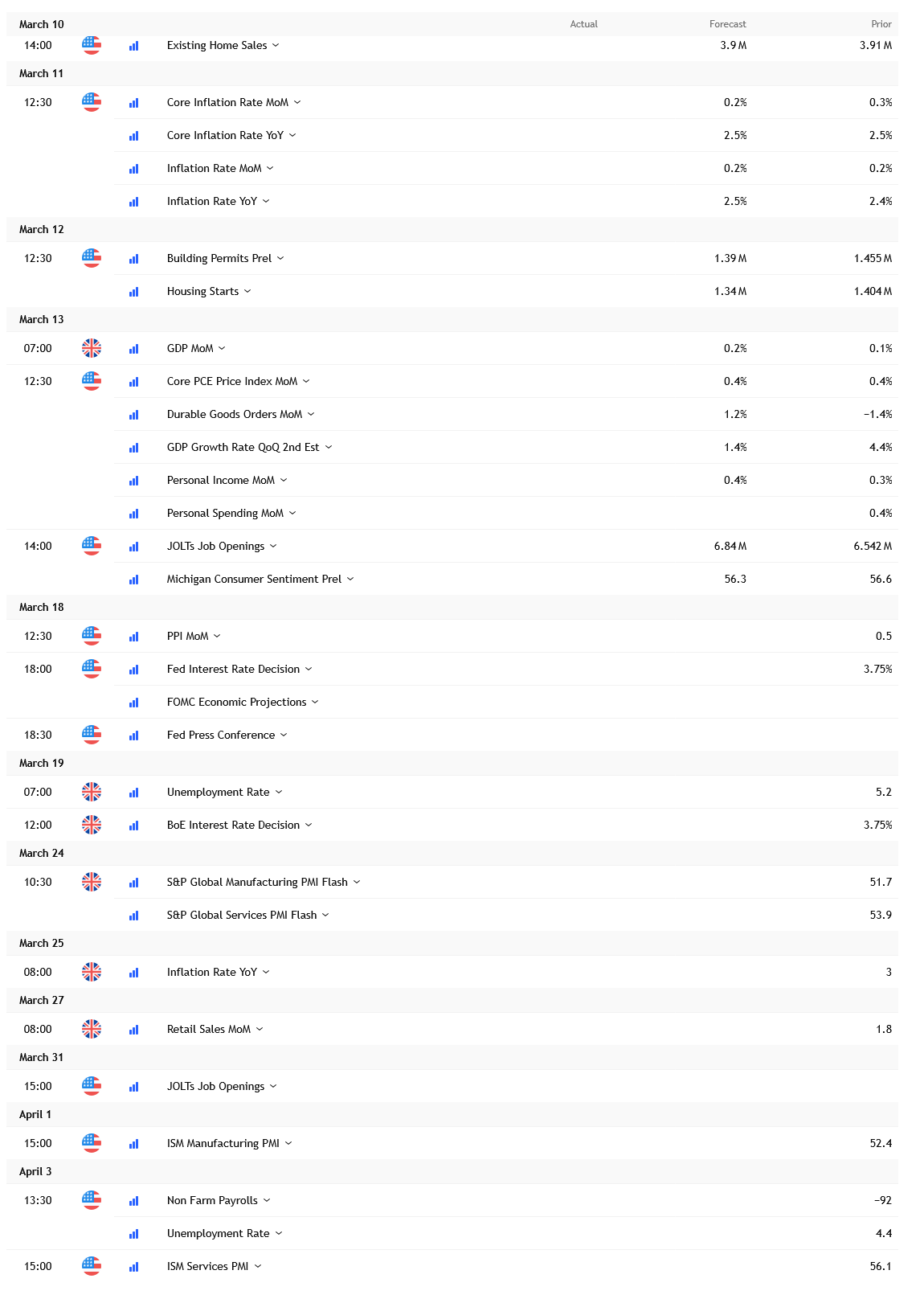
Several important macroeconomic releases could influence GBP/USD volatility during the week.
- US Consumer Price Index (CPI)
This is one of the most closely watched inflation indicators. Higher-than-expected inflation could strengthen the dollar by reinforcing expectations that the Federal Reserve will maintain restrictive policy for longer. - Core PCE Price Index
The Federal Reserve’s preferred measure of inflation. A stronger reading may support the “higher for longer” interest rate narrative and provide additional support for the US dollar. - FOMC Rate Decision
The Federal Reserve’s interest rate decision will be closely analyzed for signals about future policy direction. Any change in guidance regarding the path of interest rates could significantly influence currency markets. - Federal Reserve Economic Projections and Press Conference
Updated economic forecasts and commentary from the Federal Reserve Chair may provide further insight into policymakers’ views on inflation, growth, and the timing of potential rate adjustments.
Risk Considerations for GBP/USD This Week
Several risks could contribute to increased volatility in GBP/USD throughout the week.
One important factor is macroeconomic surprise risk. Major data releases, particularly inflation reports, can lead to sharp currency movements if the results deviate significantly from market expectations.
Another key risk relates to central bank communication. Statements from Federal Reserve officials or shifts in policy guidance may quickly alter market expectations regarding future interest rates.
Additionally, movements in US Treasury yields could influence the direction of the pair. Rising yields tend to support the dollar, while declining yields may weaken it.
Finally, the potential for technical breakouts should also be considered. If GBP/USD breaks through major support or resistance levels such as 1.3400 or 1.3100, the move could trigger increased momentum as market participants adjust their positions.

Risk disclaimer: CFDs are complex instruments and come with a high risk of losing money rapidly due to leverage. You should consider whether you understand how CFDs work and whether you can afford to take the high risk of losing your money. Never deposit more than you are prepared to lose. Professional client’s losses can exceed their deposit. Please see our risk warning policy and seek independent professional advice if you do not fully understand. This information is not directed or intended for distribution to or use by residents of certain countries/jurisdictions including, but not limited to, USA & Countries included in the OFAC sanction list. The Company holds the right to alter the aforementioned list of countries at its own discretion.
TIOmarkets offers an exclusively execution-only service. The views expressed are for information purposes only. None of the content provided constitutes any form of investment advice. The comments are made available purely for educational and marketing purposes and do NOT constitute advice or investment recommendation (and should not be considered as such) and do not in any way constitute an invitation to acquire any financial instrument or product. TIOmarkets and its affiliates and consultants are not liable for any damages that may be caused by individual comments or statements by TIOmarkets analysis and assumes no liability with respect to the completeness and correctness of the content presented. The investor is solely responsible for the risk of his/her investment decisions. The analyses and comments presented do not include any consideration of your personal investment objectives, financial circumstances, or needs. The content has not been prepared in accordance with any legal requirements for financial analysis and must, therefore, be viewed by the reader as marketing information. TIOmarkets prohibits duplication or publication without explicit approval.
Join us on social media




Behind every blog post lies the combined experience of the people working at TIOmarkets. We are a team of dedicated industry professionals and financial markets enthusiasts committed to providing you with trading education and financial markets commentary. Our goal is to help empower you with the knowledge you need to trade in the markets effectively.
Related Posts